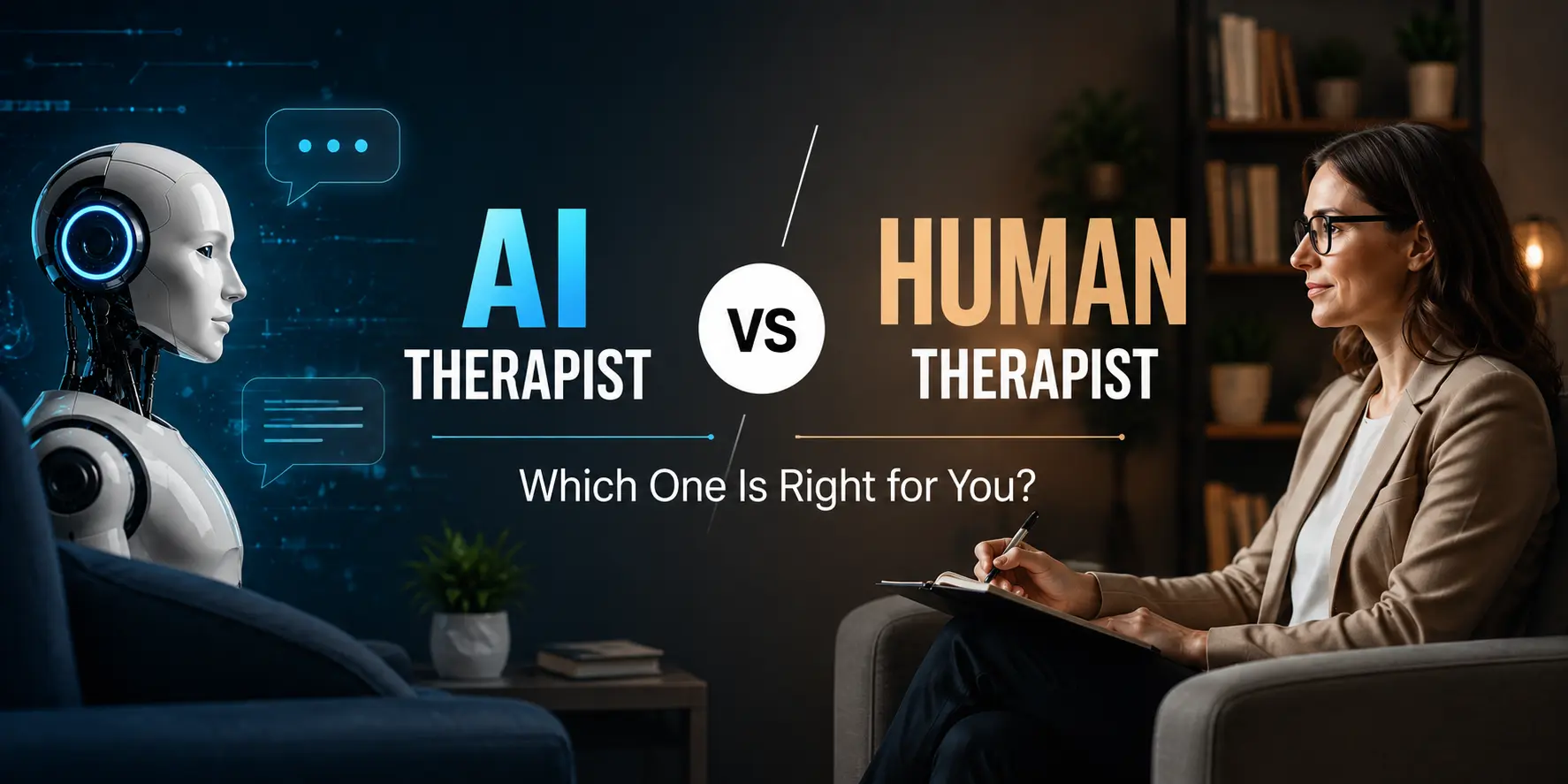
It usually starts when you are already tired.
Maybe it is late at night. Maybe you are sitting alone with thoughts you cannot turn off. Maybe you know you need to talk to someone, but booking a therapist feels expensive, slow, or just too big of a step right now.
Then you hear about AI therapists and wonder:
Can this actually help?
The honest answer is yes, it can help.
But not in every situation.
An AI therapist and a human therapist are not the same thing. They both can support people, but they are useful in different ways. If you understand that difference clearly, you can make a better choice for yourself.
So let’s talk about it simply.
The Short Answer
A human therapist is better for deep clinical care.
An AI therapist is better for instant, private, everyday emotional support.
That is the cleanest way to say it.
If you need diagnosis, trauma treatment, medication support, crisis help, or a long-term therapeutic relationship, you need a qualified human professional.
If you need someone to talk to right now, somewhere private to process your thoughts, or a low-pressure place to start opening up, an AI therapist can be useful.
It is not about one replacing the other.
It is about knowing what each one is good for.
What an AI Therapist Actually Does
An AI therapist is not just a random chatbot saying, “That sounds hard.”
At least, a good one should not be.
A good AI therapist should help you slow down, understand what you are feeling, reflect on your thoughts, and move through the moment with a little more clarity.
It can help you talk through anxiety, stress, overthinking, loneliness, relationship confusion, low mood, or the kind of emotional heaviness that is hard to explain to another person.
It can ask questions like:
What happened before you started feeling this way?
What thought keeps coming back?
What emotion feels strongest right now?
What would help you feel a little safer in this moment?
What is one small step you can take next?
That kind of support can genuinely help, especially when you are alone and your thoughts are getting louder.
But it has limits.
An AI therapist should not diagnose you. It should not pretend to be a doctor. It should not replace licensed therapy. And it should not be your only support if you are in crisis or feel unsafe.
AI therapy is best understood as emotional support and guided reflection.
Not clinical treatment.
What a Human Therapist Brings
A human therapist brings something AI cannot fully copy.
A real relationship.
That matters more than people think.
A good therapist does not only respond to your words. They notice your patterns over time. They remember your story. They hear what you avoid saying. They can notice when your tone changes, when your body shuts down, when you laugh while talking about something painful, or when you keep blaming yourself for things that were not your fault.
They can also diagnose conditions, create treatment plans, support trauma work, manage risk, refer you to specialists, and help with serious mental health struggles.
That kind of care requires training, responsibility, and human judgment.
AI cannot replace that.
If you are dealing with severe depression, trauma, suicidal thoughts, self-harm urges, abuse, psychosis, panic that is affecting your life, or anything that feels unsafe, please do not rely on AI alone.
That is the point where human support matters.
Where AI Therapy Can Be Better
Now here is the part people sometimes ignore.
AI therapy does have real advantages.
Not because it is better than a great therapist.
But because it is available when a therapist is not.
A human therapist has appointments. An AI therapist is there at midnight, on Sunday, after a fight, before an exam, or during one of those moments when you need to talk but do not want to bother anyone.
AI is also lower pressure.
Some people find it easier to open up to AI because there is no fear of being judged. No awkward eye contact. No worry about disappointing someone. No fear that the person will remember you differently tomorrow.
You can start with the messy version of the truth.
That can be powerful.
AI can also be more affordable and easier to access. Therapy can be expensive. Waiting lists can be long. In some places, finding a therapist is almost impossible. For people in that situation, AI is not replacing therapy.
It is replacing silence.
And silence is not always safe or healthy.
The Real Difference
The real difference is not just human vs AI.
It is depth vs access.
A human therapist gives depth.
An AI therapist gives access.
A human therapist can build a long-term healing relationship with you.
An AI therapist can be there instantly when you need to talk.
A human therapist can diagnose and treat.
An AI therapist can help you reflect and calm down.
A human therapist is better for serious or complex mental health care.
An AI therapist is useful for daily emotional support, check-ins, and the moments between human support.
Both can matter.
But they should not be confused.
When an AI Therapist Makes Sense
An AI therapist may be helpful if you are not in immediate danger, but you need somewhere to talk.
It can make sense if:
You are overthinking and need to organize your thoughts.
You feel lonely and want a private space to express yourself.
You are stressed and need help calming down.
You want to practice talking about your feelings before telling a human.
You cannot afford therapy right now.
You are waiting for a therapy appointment.
You want support between sessions with a human therapist.
In those situations, AI therapy can be a useful tool.
Not perfect.
But useful.
Sometimes the first step is not a full clinical session. Sometimes the first step is simply saying, I am not okay, and having something respond with care.
When You Need a Human Therapist
You should choose a human therapist if your situation is serious, long-term, or unsafe.
That includes:
Suicidal thoughts.
Self-harm urges.
Severe depression.
Trauma or PTSD symptoms.
Abuse or domestic violence.
Psychosis or losing touch with reality.
Severe panic attacks.
A need for diagnosis or medication.
Mental health symptoms affecting your daily life.
In these cases, AI is not enough.
It may still help you talk through the moment while you reach out, but it should not be the main support.
A licensed professional can provide care that AI cannot.
And needing that kind of help is not weakness.
It is the right step.
Can You Use Both?
Yes.
And honestly, this is probably the future.
A human therapist for deeper healing.
An AI therapist for daily support.
That combination makes sense.
You may see a human therapist once a week, but still need support on the other six days. You may want to process something after a session. You may want to journal through a difficult emotion. You may want to calm down at night. You may want to practice what you want to say before your next appointment.
AI can help in those spaces.
It can support the in-between moments.
It can help people stay connected to their emotional work instead of waiting until the next session to say everything.
That does not replace therapy.
It can support it.
Where Soulful AI Fits In
Soulful AI is built for the moments when you need to talk, but nothing else is available.
It is not a diagnosis app. It is not a medical service. It is not a replacement for licensed therapy.
It is a private space where you can share your thoughts, talk through what you are feeling, and get supportive AI-guided conversation.
What makes Soulful AI different is that it is not only text-based. The AI Therapist experience is face-to-face, so it feels more natural than typing into a blank chat box. You can speak, reflect, and feel more present in the conversation.
For someone who feels alone, anxious, overwhelmed, or emotionally stuck, that can make the experience feel less cold.
The goal is simple.
To give people somewhere to start.
No waitlist. No pressure. No judgment.
Just a space to talk.
Talk to an AI Therapist for Free
Final Thoughts
AI therapists and human therapists are not enemies.
They are different kinds of support.
Human therapists are needed for deep, clinical, relational, and serious mental health care.
AI therapists can help with instant emotional support, reflection, check-ins, and the moments when someone would otherwise be alone.
The mistake is pretending AI can do everything.
It cannot.
But another mistake is pretending AI cannot help at all.
It can.
For many people, it may be the first place they open up. The first place they say the truth. The first step toward getting more support.
And sometimes, that first step matters.
If you're in a mental health crisis, please reach out to a licensed professional or crisis line in your country. This article is for informational purposes only.