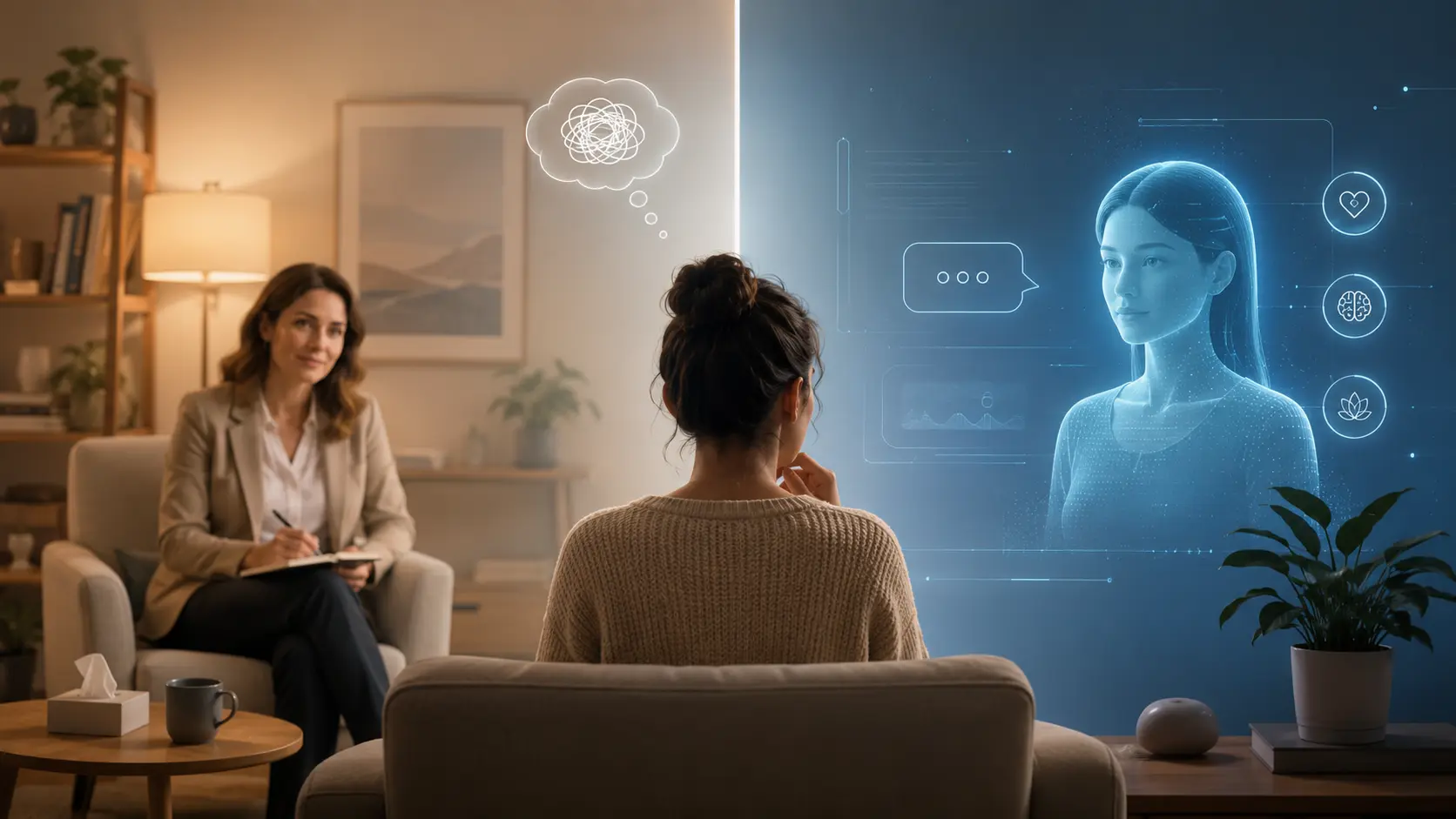
It is one of the biggest questions people are asking right now.
Will AI replace therapists?
And honestly, I understand why people ask it.
Some therapists are worried about where this technology is going. Some people are curious. And some people are asking because they are struggling right now, cannot afford therapy, cannot find a therapist, or do not want to wait weeks just to speak to someone.
So let me answer it clearly.
No, AI will not replace good human therapists.
But it may replace something else.
It may replace the silence people are left with when they cannot access therapy at all.
That is the part people often miss.
The Honest Answer
AI is not a real therapist.
It does not have lived human experience. It does not build a real long-term therapeutic relationship. It cannot diagnose you. It cannot prescribe medication. It cannot handle a serious crisis the way a trained professional can.
So no, AI should not replace licensed therapists.
But for millions of people, the choice is not really AI or a therapist.
The choice is AI or nothing.
That changes the conversation.
Because if someone is alone at 2 AM, anxious, overwhelmed, crying, overthinking, and they have nobody to talk to, an AI therapist may not be perfect, but it can still be something.
And sometimes something matters.
What Human Therapists Still Do Better
A good therapist is not just someone who gives advice.
A good therapist notices you over time. They remember your patterns. They understand your story. They can see when your words say one thing but your body is saying something else. They can sit with grief, trauma, shame, and silence in a way that comes from real training and real human presence.
That is not easy to replace.
Therapy is also built on relationship.
Not just conversation. Relationship.
That difference matters.
AI can talk to you. It can respond. It can guide you. It can help you reflect. But it does not truly know you the way a human therapist can know you after months or years of working together.
There is also the clinical side.
If someone needs a diagnosis, medication, trauma treatment, crisis support, safety planning, or professional mental health care, that needs a trained human professional. AI should not pretend to do that.
So the honest answer is this:
AI can support people.
But it should not replace the kind of care that needs human judgment, responsibility, and relationship.
What AI Can Actually Help With
Now, here is where AI becomes useful.
AI can be available immediately.
No waiting list. No appointment. No awkward call. No need to explain to a receptionist why you need help. No waiting three weeks while your mind is already too loud tonight.
That availability matters.
A lot of people do not need a full clinical session every single time they feel bad. Sometimes they need a space to talk. To calm down. To say the messy thing. To understand what they are feeling. To get through the next hour without spiraling.
AI can help with that.
It can help you reflect on your thoughts. It can help you slow down. It can ask questions. It can guide breathing or grounding. It can help you organize what you want to say to someone. It can help you feel less alone in the moment.
And for many people, that is already more support than they currently have.
Why Some People Open Up More Easily to AI
This is one of the things I find most interesting.
Some people are more honest with AI than they are with humans.
Not because AI is better.
Because AI feels safer.
You do not have to worry about being judged. You do not have to manage someone’s reaction. You do not have to wonder if they will look at you differently tomorrow. You can say something embarrassing, painful, confusing, or unfinished, and just start there.
That can be powerful.
For someone who is anxious, ashamed, lonely, or scared to open up, AI can be a first step.
Not the final step.
But a first one.
Sometimes people need to say the truth somewhere safe before they are ready to say it to a person in their life.
The Real Problem Is Access
The biggest issue in mental health is not that too many people are getting perfect therapy.
The problem is that too many people are getting no support at all.
Therapy is expensive. In many places, it is hard to find. Waiting lists can be long. Some people live in areas where there are very few therapists. Some people do not speak the language of available providers. Some people cannot afford even one session.
So when people ask, will AI replace therapists, I think the better question is:
What are we offering to people who currently have nothing?
Because for those people, AI is not replacing therapy.
It is filling a gap.
It is not the whole answer, but it may be part of the answer.
The Future Is Probably Both
I do not think the future is AI instead of therapists.
I think the future is AI plus therapists.
AI can help with everyday support, emotional check-ins, guided reflection, journaling, breathing, CBT-style thought work, DBT-style grounding, and those late-night moments when a person needs to talk but has nobody available.
Human therapists can focus on the deeper work.
Trauma. Diagnosis. Complex patterns. Crisis care. Long-term healing. Relationship-based therapy. Clinical judgment. The things that require a real human being.
That future actually makes sense.
AI can support the spaces between human support.
It can help people not feel completely alone while they are waiting, saving money, building courage, or trying to understand what they need.
Used honestly, AI does not have to be a threat to therapy.
It can be a bridge toward support.
Where Soulful AI Fits In
I built Soulful AI because I believe people deserve somewhere to talk when life feels too much.
Not everyone can afford therapy. Not everyone is ready to open up to a therapist. Not everyone has someone safe to call at night. And sometimes people just need a private space where they can say what they are feeling without being judged.
Soulful AI is not trying to be your psychiatrist.
It is not trying to diagnose you.
It is not trying to replace a therapist who knows your full story.
What it is trying to do is simple.
Be there when nothing else is available.
A face-to-face AI therapist experience. A calm space. A private conversation. A way to talk through stress, overthinking, loneliness, emotional pain, or whatever is sitting heavy in your mind.
Not perfect.
Not clinical treatment.
But present.
And sometimes, when someone is struggling, present is a lot better than nothing.
Final Thoughts
AI will not replace human therapists.
But it will change how people access emotional support.
And honestly, I think that can be a good thing if we stay clear about the limits.
AI should not diagnose people. It should not pretend to be a licensed therapist. It should not replace crisis care. It should not replace real human connection when that is what someone needs.
But it can help people talk.
It can help people reflect.
It can help people feel less alone.
And for people who currently have no support at all, that matters.
The future of mental health support should not be human therapy or AI.
It should be both, used honestly.
Human care for the deep work.
AI support for the moments in between.
If you are experiencing a mental health crisis, feel unsafe, or may hurt yourself or someone else, please contact emergency services, a licensed professional, or a crisis helpline in your country. This article is for informational purposes only and does not replace professional mental health care.